

What Are Peptides Used For in Research? A Scientific Overview

Peptides are used in laboratory research to study how short amino acid chains bind to specific cell receptors and trigger biological responses. Researchers use them to investigate metabolic regulation, tissue repair, growth hormone signaling, cellular aging, and skin biology. Because peptides mimic naturally occurring signaling molecules, they let scientists isolate a single biological pathway and observe it under controlled conditions. Research peptides are not approved drugs and are intended strictly for laboratory use by qualified professionals, not for human or animal consumption.
Key Takeaways
- Peptides are short chains of amino acids, generally under 50 residues, that bind to specific cell receptors.
- Their small size and structural precision make them useful tools for isolating individual signaling pathways in cell and animal studies.
- Major research categories include metabolic regulation, tissue repair, growth hormone axis studies, cellular aging, and skin/structural biology.
- Purity and third-party verification directly affect whether an observed effect can be attributed to the compound itself.
- Research peptides are not approved for human or veterinary use and are sold strictly for laboratory research.
Did You Know?
Global interest in peptides has surged in recent years. Google searches for the term “peptides” worldwide climbed from roughly 1.3 million per month in 2024 to around 8 million per month in 2026, according to reporting in Nature. That spike in public interest is a big part of why understanding what these compounds are actually used for in legitimate research, as opposed to unverified consumer trends, matters more than ever.
What Is a Peptide?
A peptide is a short chain of amino acids joined by peptide bonds. It sits between a single amino acid and a full protein in terms of size and complexity. Most peptides used in research contain somewhere between two and fifty amino acid residues, which keeps them small enough to synthesize with precision while still allowing meaningful interaction with biological systems.
This matters for one core reason. A large number of research peptides are modeled directly on signaling molecules the body already produces, including growth hormone releasing hormones, growth factors, and structural protein fragments. That resemblance to a natural template is what gives them a defined, studyable target in the first place. For a broader look at how peptide science is evolving across fields, Nature’s ongoing peptide research coverage is a useful reference point for researchers who want to track the wider literature.
How Peptides Interact With Cells
Most research peptides work through receptor mediated signaling. A peptide binds to a receptor on the surface of a cell, and that binding event sets off a chain reaction inside the cell, activating enzymes, switching gene expression on or off, or prompting the release of other signaling molecules.
This kind of receptor selectivity is what makes peptides attractive as research tools. Because a peptide tends to engage a specific receptor type rather than acting broadly across many systems, researchers can isolate one pathway at a time and observe it without as much interference from unrelated biological activity.
Major Categories of Peptide Research
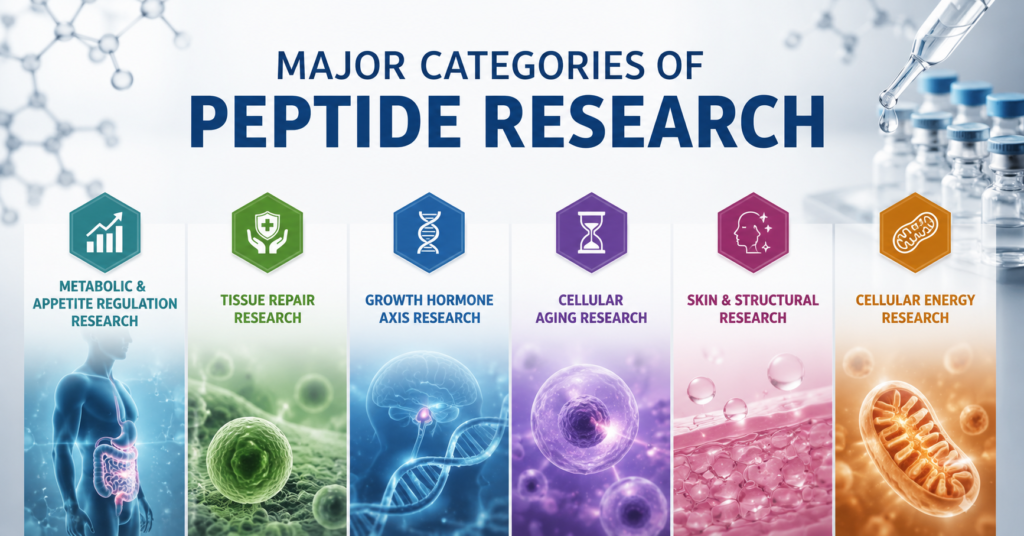
1. Metabolic and Appetite Regulation Research
A large share of current peptide research focuses on how the body manages appetite, glucose, and energy use. Retatrutide is studied for its activity across multiple receptor pathways tied to appetite signaling and lipid metabolism, which has made it a common reference point in metabolic disease research models.
2. Tissue Repair Research
Peptides such as BPC-157 and TB-500 are frequently used in models examining tissue repair, angiogenesis, and gastrointestinal protection. Researchers sometimes study the two together, which is why combination formats like the BPC-157/TB-500 blend exist as a single research format. These models give researchers a way to study the biological steps involved in wound healing and inflammation resolution at the cellular level.
3. Growth Hormone Axis Research
Compounds like CJC-1295 (no DAC) combined with Ipamorelin are studied for their role in activating growth hormone releasing hormone (GHRH) and ghrelin receptor pathways. Research in this category typically examines downstream effects on IGF-1 signaling and endocrine regulation.
4. Cellular Aging Research
Peptides like Epithalon and MOTS-c sit at the center of aging related research. MOTS-c is a mitochondrial derived peptide studied for its involvement in cellular energy metabolism and the stress response, which places it at the intersection of mitochondrial biology and longevity science.
5. Skin and Structural Research
The copper binding peptide GHK-Cu is studied for its role in collagen synthesis and extracellular matrix remodeling. It is also formulated alongside BPC-157 and TB-500 in multi-compound research formats such as the GLOW blend, which researchers use to study coordinated regenerative signaling across several pathways at once. These models are commonly used in dermatological and wound healing research. Browse the full Peptide Blends category for other multi-compound research formats.
6. Cellular Energy Research
NAD+ is not a peptide, but it is often studied alongside peptide research in the broader field of cellular metabolism, particularly its role as a coenzyme in mitochondrial function and DNA repair.
What Are Peptides Used for in Research?

| Research Area | Example Peptides | Primary Research Focus |
| Metabolic Research | Retatrutide | Appetite regulation, glucose metabolism |
| Tissue Repair | BPC-157, TB-500 | Wound healing, angiogenesis |
| Growth Hormone Research | CJC-1295, Ipamorelin | GH and IGF-1 signaling |
| Cellular Aging | MOTS-c, Epithalon | Mitochondrial function and longevity |
| Skin Biology | GHK-Cu | Collagen synthesis and extracellular matrix |
| Cellular Energy | NAD+*(non-peptide coenzyme) | Cellular metabolism and energy production |
Why Purity Determines Research Validity
Because peptide research depends on precise receptor interactions, even a small impurity or degradation product can distort results. A batch with unverified purity introduces variables that make it difficult to determine whether an observed effect came from the compound being tested or from a contaminant.
This is why third party testing and documented purity data matter as much as the compound selection itself. Every batch at Aire Peptides is independently verified to a minimum 99% purity threshold, with controls on identity, sterility, and endotoxin levels. You can review lot specific data on our Test Reports page, and our guide on how to read a COA for research peptides walks through what those numbers actually mean.
Research Peptide Quality Checklist
| Quality Factor | Why It Matters |
| HPLC Purity Testing | Confirms the peptide meets the stated purity level |
| Mass Spectrometry (MS) | Verifies the peptide’s molecular identity |
| Third-Party Testing | Provides independent validation of test results |
| Batch/Lot Number | Ensures traceability to a specific production batch |
| Certificate of Analysis (COA) | Documents purity, identity, and quality testing |
Frequently Asked Questions
Are research peptides the same as approved medications?
No. Peptides sold for research use are not approved by the FDA for human or veterinary use. They are intended strictly for in vitro and laboratory research conducted by qualified professionals.
Why are so many research peptides modeled on natural hormones?
Because a naturally occurring signaling peptide already has a defined receptor and biological pathway, it gives researchers a reliable starting template for designing a selective, targeted study compound.
Does peptide purity affect research outcomes?
Yes. Impurities or degraded compounds can introduce confounding variables, which makes it harder to attribute an observed effect to the peptide itself. Third party HPLC testing is the standard method for verifying purity before use.
Where can I find sourcing and purity documentation for a specific batch?
Aire Peptides publishes third party test reports across the catalog. Visit the Test Reports page to review batch specific data before selecting a compound.
What is the difference between a peptide and a protein?
The distinction is mainly size and complexity. Peptides are short chains of amino acids, generally under 50 residues, while proteins are longer chains that fold into complex three dimensional structures. Many peptides used in research are fragments or analogs of larger proteins.
How do researchers select which peptide to study?
Selection typically depends on the biological pathway under investigation. A researcher studying appetite regulation might select a peptide like Retatrutide, while one studying tissue repair might select BPC-157, based on which receptor system the compound is known to engage.
Can research peptides be used in human clinical trials?
Peptides used in laboratory research are not the same as compounds that have advanced through the FDA approval process for clinical use. Any peptide intended for human trials must go through a separate, regulated development and approval pathway before it can be studied in people.
Why do some research peptides come as blends rather than single compounds?
Peptide blends allow researchers to study how multiple signaling pathways interact when engaged at the same time, rather than observing one receptor system in isolation. This can be useful for modeling more complex biological processes.
Research Use Only: This article is provided for educational purposes only. All peptides referenced are intended strictly for in vitro laboratory and research use by qualified professionals. They are not drugs, foods, or cosmetics, and they are not intended for human or animal consumption. These statements have not been evaluated by the U.S. Food and Drug Administration.
Explore our research grade catalog: Shop All Peptides →