

How to Read a Certificate of Analysis (COA) for Research Peptides: A Complete Guide
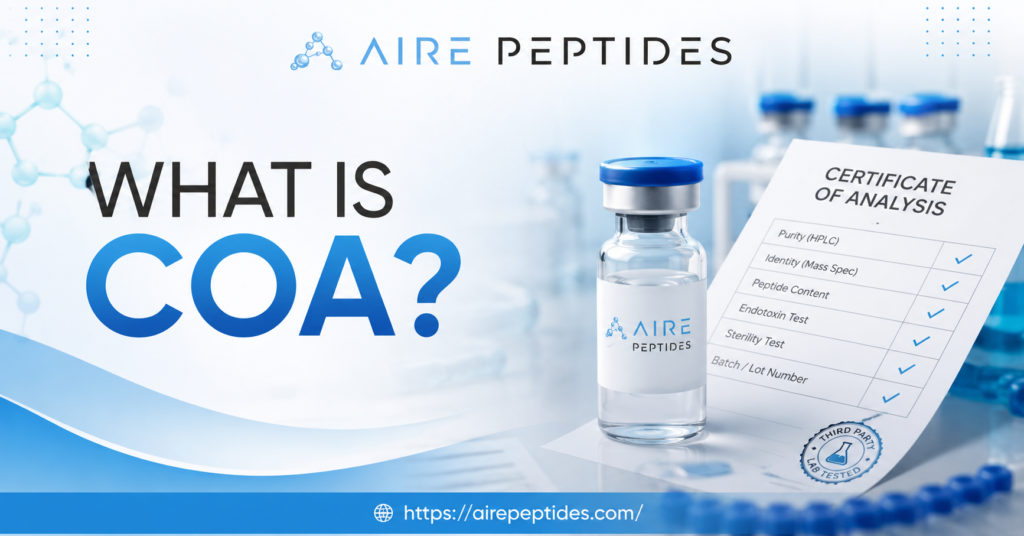
A Certificate of Analysis (COA) for a research peptide is a lab document that verifies what is actually in the vial. To read one, check five things: the purity percentage from HPLC testing, the identity confirmation from mass spectrometry, the peptide content or net peptide weight, the endotoxin and sterility results, and the batch or lot number that ties the report to the specific product you purchased. A trustworthy COA is issued by an independent third party lab, not the seller itself, and every number on it should match the batch in your hand.
Key Takeaways
- A COA is a lab verified snapshot of a specific batch, not a general claim about a product line.
- HPLC purity and mass spectrometry identity are the two most important data points on the report.
- The lot number on the COA must match the lot number on the vial or packaging.
- Endotoxin and sterility data matter for any peptide intended for cell based or in vivo research models.
- A COA from an independent lab carries more weight than one produced or self issued by the seller.
Did You Know?
Quality issues in the research peptide market are more common than many buyers assume. According to a January 2026 industry analysis reported by Hone Health, roughly 3 in 10 research-grade peptide products fail basic quality checks, including mislabeling, purity below stated thresholds, or incorrect dosing. Knowing how to read a COA is one of the few ways researchers can independently verify what they are actually receiving.
What Is a Certificate of Analysis?
A Certificate of Analysis is a document produced after a peptide batch has been tested in a laboratory. It reports what the batch actually contains, expressed through a set of standardized measurements. Instead of relying on a manufacturer’s description, a COA gives researchers verifiable, lab generated data about purity, identity, and safety markers for that specific production run.
This distinction matters. A COA is tied to a batch or lot, not to a product in general. A peptide can have excellent COA results for one production run and different results for the next if raw materials, synthesis conditions, or storage vary. That is why every reputable COA includes a lot number, and why researchers should always confirm that number against the actual vial before relying on the report.
How to Read a Certificate of Analysis (COA)
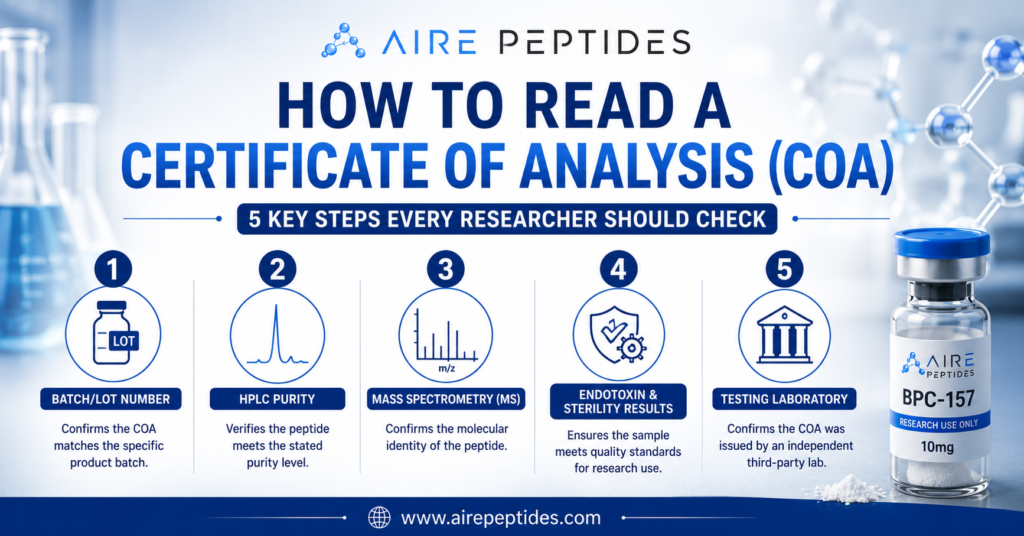
| Step | What to Check | Why It Matters |
| 1 | Batch/Lot Number | Confirms the COA matches the specific product batch. |
| 2 | HPLC Purity | Verifies the peptide meets the stated purity level. |
| 3 | Mass Spectrometry (MS) | Confirms the molecular identity of the peptide. |
| 4 | Endotoxin & Sterility Results | Ensures the sample meets quality standards for research use. |
| 5 | Testing Laboratory | Confirms the COA was issued by an independent third-party lab. |
The Five Sections to Check on Every COA
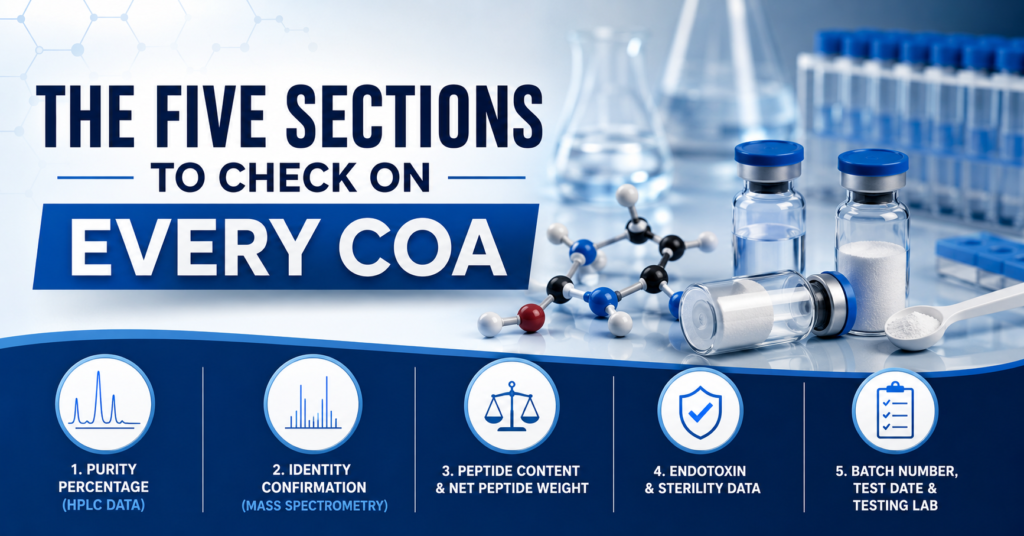
1.Purity Percentage (HPLC Data)
High Performance Liquid Chromatography, or HPLC, is the standard method used to measure how pure a peptide sample is. The result appears as a percentage, and it should be clearly visible near the top of the report. Reputable research peptides typically report 98 percent purity or higher, and the report should include the actual chromatogram, not just a stated number, so the data can be independently reviewed. Peer reviewed methodology on how HPLC is validated for peptide purity testing is available through PubMed Central for researchers who want to understand the underlying analytical process in more depth.
A low or unstated purity percentage is one of the clearest warning signs on a COA. If a report shows purity below industry standard without explanation, or omits the number entirely, treat that as a signal to look elsewhere.
2. Identity Confirmation (Mass Spectrometry)
Purity alone does not confirm that the vial contains the correct peptide. Mass spectrometry, often shown as MS or LC-MS on a report, confirms the molecular weight of the compound and verifies that it matches the expected sequence for that peptide. This is the step that answers a different question than HPLC does: not how clean is this sample, but is this actually the compound it claims to be.
A complete COA includes both HPLC purity data and mass spectrometry identity confirmation. A report with only one of the two leaves a meaningful gap in verification.
3. Peptide Content and Net Peptide Weight
Peptide content, sometimes listed as net peptide weight or peptide content percentage, tells you how much of the vial’s total mass is actually the active peptide, as opposed to counter ions, moisture, or other residual material from synthesis. This figure matters for research involving precise concentration or dosing calculations in a study protocol, since two vials labeled with the same total weight can contain meaningfully different amounts of active peptide if their net content differs. This is especially relevant for multi-compound formats like the BPC-157/TB-500 blend or the GLOW blend, where net content should be reported for each individual peptide in the formulation, not just the total.
4. Endotoxin and Sterility Data
For any peptide intended for cell culture work or in vivo animal models, endotoxin levels and sterility testing are critical. Endotoxins are bacterial byproducts that can trigger an inflammatory response in biological systems, which can confound research results even when the peptide itself is correctly identified and pure. A COA intended for research use should report endotoxin levels in EU/mg (endotoxin units per milligram) and confirm the batch passed sterility testing where applicable.
5. Batch Number, Test Date, and Testing Lab
The final section to check is administrative, but it is what makes the entire document verifiable. Look for a batch or lot number, the date testing was performed, and the name of the laboratory that conducted the analysis. Cross check the lot number against your product packaging. If a seller cannot produce a COA that matches the batch you received, the report has no real connection to what is actually in your hands.
Third Party Testing vs. Self Reported Data
The single most important factor in evaluating a COA is who produced it. A third party lab has no financial interest in the outcome of the test, which makes its results far more reliable than data generated or summarized internally by the seller. When reviewing a COA, look for the name of an independent testing laboratory on the document itself, and be cautious of reports that only present a company’s own summary of results without an identifiable outside lab behind them.
Aire Peptides publishes independent, batch specific COA data for every product in the catalog, verified to a minimum 99% purity threshold. You can review current lot data on our Test Reports page before selecting a compound for your research. For background on how these compounds are used in practice, see our overview on what peptides are used for in research.
Red Flags That Signal an Unreliable COA
- No lot number, or a lot number that does not match the product packaging
- Purity stated as a round, generic number with no accompanying chromatogram
- Missing mass spectrometry data, so identity is never actually confirmed
- No named third party testing lab, or a lab that cannot be independently verified
- A COA that is clearly reused across multiple, unrelated batches
Common COA Red Flags
Red Flag |
Why It's a Concern |
Missing or mismatched lot number
|
The COA cannot be verified against the product batch.
|
No HPLC chromatogram
|
Purity claims cannot be independently reviewed.
|
Missing Mass Spectrometry data
|
The peptide's identity has not been confirmed.
|
No named third-party laboratory
|
Results may lack independent verification.
|
Generic or reused COA
|
May not represent the actual batch being purchased.
|
Frequently Asked Questions
Is a COA the same as a product label?
No. A product label describes what the seller states is in the product. A COA is a lab generated report that verifies those claims through actual testing, tied to a specific batch.
What purity level should a research peptide COA show?
Most reputable research peptides report 98 percent purity or higher via HPLC testing. Reports should include the underlying chromatogram data, not just a stated percentage.
Why does the lot number matter so much?
The lot number connects the COA to one specific production run. Without a matching lot number, there is no way to confirm the report actually describes the vial you received.
Can a seller write their own COA?
A seller can present testing data, but a COA carries far more weight when it is generated by an independent third party laboratory rather than the seller itself, since third party labs have no financial stake in the result.
What does EU/mg mean on an endotoxin report?
EU/mg stands for endotoxin units per milligram. It measures how much bacterial endotoxin is present relative to the amount of peptide in the sample. Lower values indicate a cleaner sample, which matters most for cell culture and in vivo research models where an inflammatory response could confound results.
What should I do if a COA does not match the batch I received?
Contact the supplier and request a COA that corresponds to the specific lot number printed on your vial or packaging. A COA that cannot be matched to your actual product provides no meaningful verification and should not be relied on for research purposes.
How often should a COA be updated?
A new COA should be issued for every production batch, since purity and identity results can vary between runs even for the same peptide. A single COA reused across multiple, unrelated batches is a red flag rather than a sign of consistency.
Does a high purity percentage guarantee a peptide is safe for research use?
No. Purity confirms how clean the sample is, but it does not by itself confirm identity, sterility, or endotoxin status. A complete COA reviews all of these factors together, not purity in isolation.
Research Use Only: This article is provided for educational purposes only. All peptides referenced are intended strictly for in vitro laboratory and research use by qualified professionals. They are not drugs, foods, or cosmetics, and they are not intended for human or animal consumption. These statements have not been evaluated by the U.S. Food and Drug Administration.
Review current batch data: View Test Reports →